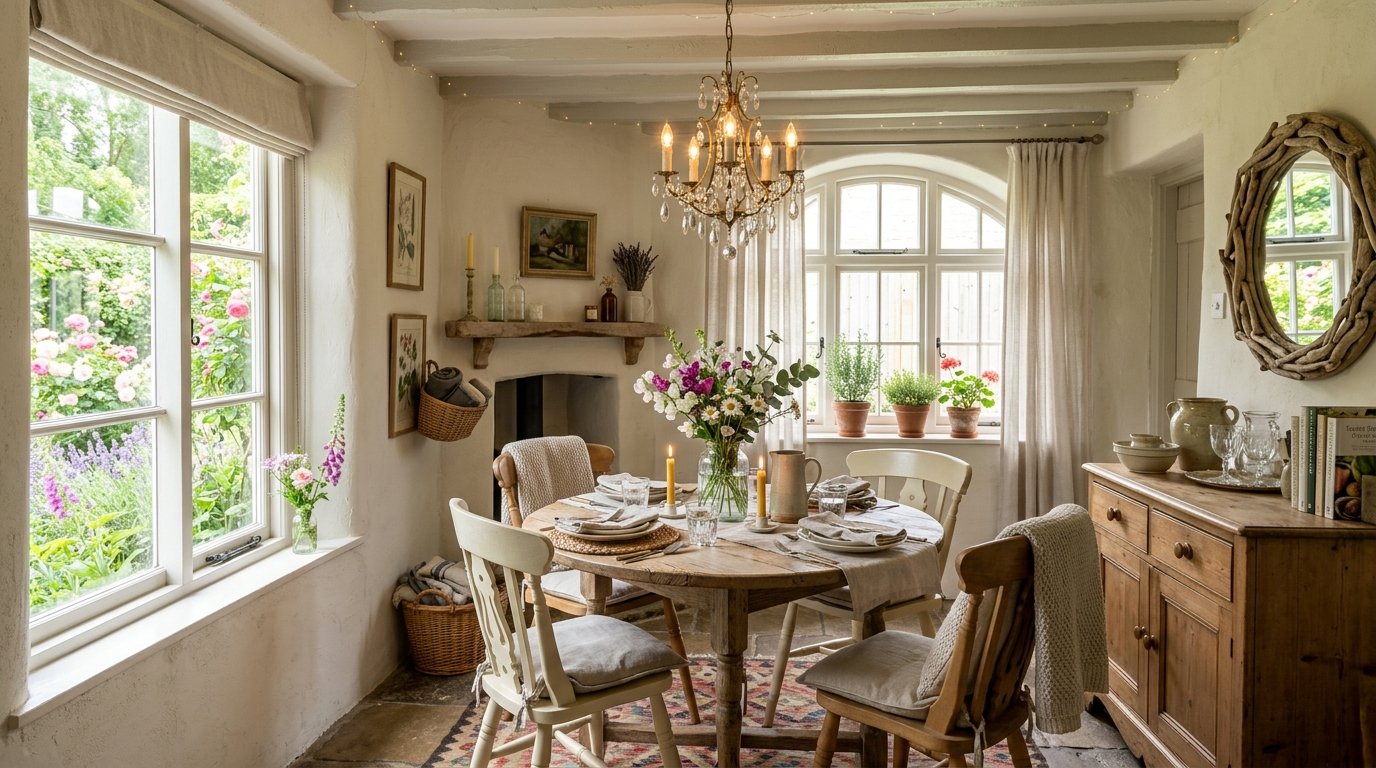
You know that tiny corner where your table almost touches the wall and if someone pulls the chair too far back the whole room sighs. That’s your small cottage dining room, and honestly it’s more personality per square foot than most oversized formal spaces ever manage. Smaller rooms hold heat, hold conversation, hold crumbs and candle smoke and Sunday stew smell. There’s something stubbornly charming about them.
In many older cottages, especially ones built before the 1980s, the dining area was rarely a grand separate room. Census housing data shows the average new single family home in the US now exceeds 2300 square feet, but mid century cottages were often under 1200. So your dining room being petite is not a flaw. It’s history still breathing. And maybe creaking.
Why a Small Cottage Dining Room Feels Different
A cottage style dining room isn’t trying to impress your boss. It’s trying to make your aunt stay longer for tea. The walls are closer, yes, but so are people. Sound doesn’t echo as much. Laughter sort of lingers, bounces once, settles.
You’ll notice how natural light matters more in a compact space. A south facing window can completely change the mood at 4 pm. The National Renewable Energy Laboratory has shown that daylight improves mood and productivity in homes and workplaces. I mean, you probably didn’t need a lab to tell you that, but still. It’s nice to know science backs your instinct to chase light like a housecat.
And because it’s small, every chair leg, every wood grain, every chip in the paint becomes louder. You cannot hide sloppy choices here. Which is annoying, but also freeing.
Choosing the Right Table for a Cottage Dining Room
Let’s talk table. Because if you get this wrong, you’ll be bumping hips for years.
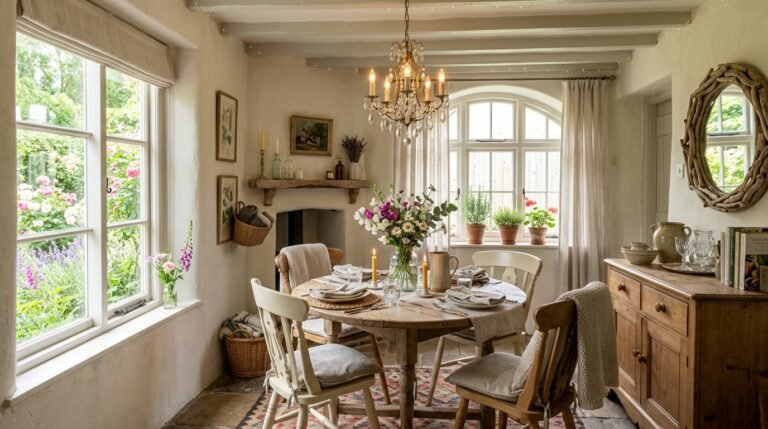
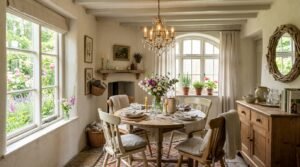
A round dining table for small space often wins. Circles soften corners and help traffic flow. In a room under 10 by 10 feet, a 36 to 42 inch round table usually fits comfortably for four. If your cottage dining room is more like a converted nook, even 30 inches might do. I once squeezed a 36 inch table into a space that technically wanted 30. It worked, but barely. We learned to inhale when someone stood up.
Drop leaf tables are classic in small cottage interiors. You fold them down when it’s just you and your coffee. Open them when friends show up with pie. That flexibility feels very cottage, very practical, slightly romantic in a flour on your hands sort of way.
Wood matters too. Pine, oak, even reclaimed boards with nail holes still visible. Smooth lacquered glass tables can feel cold in a cottage. Not wrong, just a little too city. And cottage rooms are usually whispering countryside, even if you live two blocks from a gas station.
Seating That Doesn’t Crowd the Soul
Chairs eat space. They just do. Standard dining chairs need about 24 inches of width per person. And about 36 inches clearance from table edge to wall for easy movement. In a tiny cottage dining room layout, that clearance is gold.
Benches are sneaky good. A built in bench against the wall with storage underneath solves two problems at once. You gain hidden storage for table linens or random board games, and you save those precious inches because nobody needs space behind the bench. It’s already against the wall, obviously.
Mixing chairs works better than matching sets. A pair of slim spindle back chairs on one side, a bench on the other, maybe an old painted chair at the head. It looks collected. And if one breaks, you don’t feel like you’ve ruined a matched set from some catalog.
There’s a small human psychology thing here too. Studies in environmental psychology suggest varied textures and shapes make spaces feel layered and interesting, even when square footage is limited. So your mismatched chairs are not just cute. They are quietly clever.
Color Choices That Expand a Cottage Dining Room
Everyone says white walls. And yes, light colors reflect more light, which can make a room feel larger. But pure white in a small cottage dining room design sometimes feels sterile. You want warmth, not a dentist waiting room.
Soft creams, muted sage, dusty blue, pale greige. Colors that look like they’ve been sun washed for years. Light colors with a bit of earth in them. That’s the trick.
If you crave darker tones, try them below chair rail height. A deeper green or navy on the lower half of the wall can ground the room, while keeping the upper portion light maintains brightness. It’s a small optical trick. Not magic, just contrast.
And don’t forget ceilings. A slightly lighter shade on the ceiling than the walls can create the illusion of height. I once painted a cottage dining room ceiling a very pale sky blue. Barely there. Guests kept glancing up and saying the room felt taller, though it wasn’t. Funny how paint plays games with the brain.
Lighting in a Small Cottage Dining Room
Overhead lighting can either bless or curse your space. A heavy chandelier in a tiny room feels like it’s about to bonk someone on the head. Scale matters more than style sometimes.
In smaller rooms, fixtures under 20 inches in diameter often feel proportionate. If your ceiling is standard 8 feet high, hanging the bottom of the light about 30 to 34 inches above the table usually works. Too low and people squint. Too high and it loses intimacy.
Layering helps. A small pendant above the table, plus a wall sconce or even a petite table lamp on a sideboard. Light at different heights makes the room feel fuller, more dimensional. The Illuminating Engineering Society has long emphasized layered lighting in residential design. You don’t need to read their technical guides to know one lonely ceiling bulb looks sad.
Candles, of course. Because cottage dining rooms and candles are old friends.
Storage Without Bulk
You want storage, but bulky hutches can swallow the room. Try a slim cottage style sideboard under 18 inches deep. That’s usually enough for plates and serving dishes without crowding pathways.
Open shelving works if you’re disciplined. If not, it becomes a visual traffic jam. I’ve done both. One looked charming, the other looked like a thrift store mid sneeze.
Hooks on the wall for baskets or lightweight decor can add function without floor space. Vertical storage is your ally. Walls are underused in small dining rooms, and they shouldn’t be.
Textiles and Texture, the Quiet Heroes
Rugs define the dining zone, especially in open cottage layouts. Make sure the rug extends at least 24 inches beyond the table edges so chairs stay on it when pulled out. Otherwise you get that awkward leg catching moment. Everyone pretends it didn’t happen.
Natural fibers like jute or wool feel right in a cozy cottage dining room. They bring warmth, soften footsteps, and visually ground the table.
Curtains should be light, maybe linen or cotton. Heavy drapes in a tiny room can feel like the walls are closing in. Unless you’re going for dramatic cottage, which is a whole other conversation.
Personal Details That Make It Yours
A small room cannot handle clutter, but it can handle meaning. A single framed botanical print. A vintage clock that ticks too loudly. A bowl you picked up on vacation and slightly overpaid for. These things make the small dining room decor feel lived in, not staged.
Cottages have a way of forgiving imperfection. A scratch in the table becomes a story. A slightly crooked shelf becomes character. In larger, more polished homes, those same flaws would glare.
And honestly, that’s the secret. A small cottage dining room is not about perfection. It’s about proportion, light, comfort, and memory. You adjust, you rearrange, you bump into chairs sometimes. You repaint when the mood shifts. It’s an evolving little box of warmth.
You might think you need more space. Maybe you do. But sometimes you just need better scale, softer colors, a table that fits like it belongs there all along. The room won’t grow. But it can feel generous.
And that’s enough, isn’t it.