
You think you love French country design, and maybe you do, but sometimes what you’re actually loving is a Pinterest-filtered postcard version of rural Provence, not the slightly chipped, sun-washed, quietly imperfect reality of it. And that difference, tiny as it sounds, is where most French country decor mistakes begin.
I’ve seen homes where someone tried to recreate a French farmhouse kitchen and it looked less countryside in France and more themed restaurant off a highway exit. Which hurts a little, because the style itself is generous, layered, forgiving. You just have to not strangle it with enthusiasm.
Let’s untangle this slowly. Maybe with a chipped ceramic bowl nearby.
Thinking French Country Means “More Stuff, Always More Stuff”
There’s this odd belief that French country interiors must be overflowing. More florals. More carved wood. More distressed paint. Add another rooster. Why not.
But actual rural homes in Provence or Normandy were practical spaces. They weren’t styled for a camera. Historically, these houses centered around heavy wood tables, simple linen textiles, stone floors, and plaster walls. The French countryside was agricultural, not decorative theater.
According to tourism and cultural preservation records in France, many preserved 18th and 19th century farmhouses had very limited ornamentation. Storage was functional. Open shelving showed everyday crockery because that’s what they owned, not curated collections of twelve matching lavender jars.
When you overload your space with faux distressing and decorative clutter, you flatten the depth. It becomes costume design. French country style actually needs breathing room. Let the wood speak. Let the stone be stone. Not everything must have a scroll carved into it.
I once visited a home where every single drawer pull was shaped like a fleur-de-lis. Every one. I felt dizzy.
Confusing Rustic With Rough and Forgotten
You want rustic French decor, but instead you end up with neglected farmhouse energy. There is a difference. A big one.
Rustic in French country style means time-worn beams, aged patina, natural materials like oak and limestone. It does not mean cracked vinyl flooring or peeling laminate cabinets. Real rustic has integrity. Structural honesty.
Old farmhouses in southern France often used local limestone for walls and clay tiles for roofs. These materials age gracefully. They soften. They do not look abandoned.
If your French country kitchen cabinets are aggressively distressed with five different sandpaper passes and random dark glaze smeared into corners, it can feel forced. Real aging happens unevenly. It tells a story. Artificial distressing often screams at you.
You want quiet character. Not loud “I attacked this with a chain from the garage.”
Overdoing the Color Palette
Here’s where people go full sunflower field.
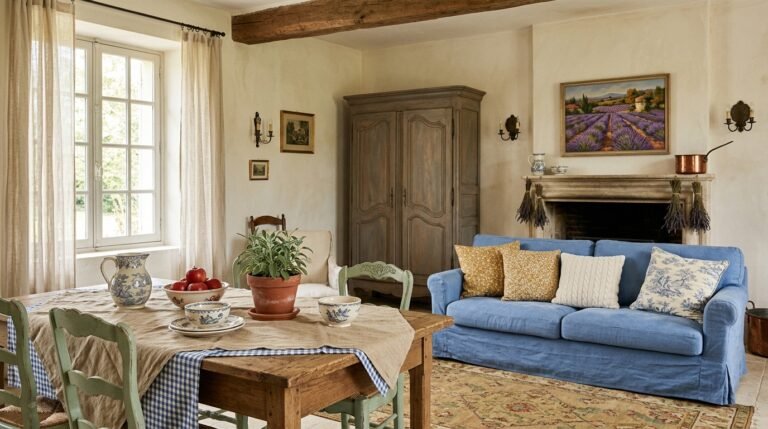
Yes, French country color palettes include warm yellows, muted blues, sage greens, creamy whites. Inspired by lavender fields and wheat. But subtle, dusty, sun-faded tones. Not neon lemon. Not high-gloss cobalt.
The countryside light in Provence is soft. Many traditional homes used lime-washed walls, which naturally diffuse color. When you use saturated modern paint with high sheen, you lose that effect entirely.
A 2023 interior paint trend report showed that soft neutrals and desaturated earth tones dominated European rural renovation projects. That makes sense. The charm comes from age and warmth, not intensity.
If your living room looks like a jar of mustard exploded, you might need to recalibrate.
Buying All Matching Furniture Sets
This one hurts because it’s convenient.
You walk into a showroom. They have a “French Country Collection.” Bed, dresser, nightstands, mirror, all identical carvings, same finish, same everything. Easy, right?
But authentic French country furniture evolved over time. Pieces were inherited, repaired, repurposed. A farmhouse table from one generation, a provincial armoire from another region. Slight differences. Slight mismatches.
Uniformity kills soul. It becomes staged. French homes often mix pieces from Louis XV inspired curves with simpler peasant tables. It’s layered history, not catalog precision.
Your space should feel gathered. Not purchased in a single Saturday afternoon.
Ignoring Architectural Bones
This one is sneaky.
You add toile curtains, maybe a vintage chandelier, some open shelving. But the bones of the room scream modern suburban box. And the tension is noticeable.
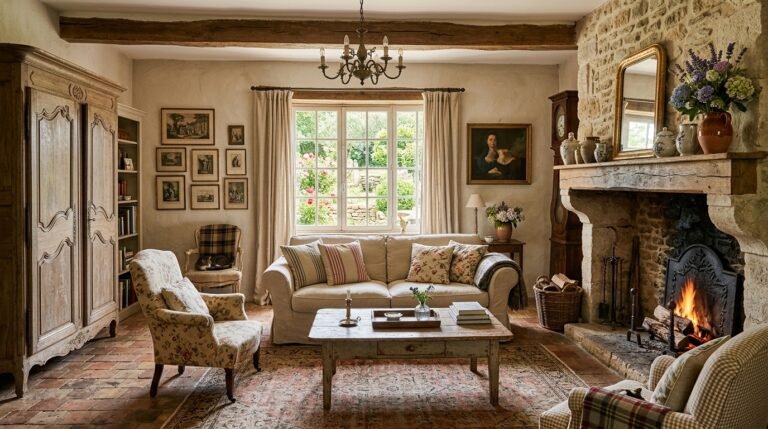
Traditional French country homes featured thick plaster walls, exposed beams, arched doorways, stone or terracotta floors. You don’t need all of that, obviously. But you should at least nod to the structure.
If your ceiling is standard drywall and you install fake foam beams that look like hollow props, the illusion collapses. People can sense it. Even if they can’t explain why.
Sometimes restraint works better. A simple lime-wash finish. A textured wall. Real wood shelving instead of MDF with veneer pretending.
The charm lives in materials. Not props.
Treating It Like Shabby Chic
Let’s be honest. French country decor and shabby chic got tangled in the 1990s. But they are not twins.
Shabby chic leans heavily on white paint, heavy distressing, lace, overly romanticized florals. French country can be romantic, yes, but it’s grounded. It’s rooted in rural practicality.
When every surface is painted white and sanded down, you erase warmth. Many authentic French interiors actually use rich wood tones. Walnut. Oak. Deep brown beams. Not everything was bleached.
You need contrast. Cream walls against dark wood. Stone against linen. Texture against smooth ceramic.
Without that contrast, it floats away.
Forgetting Function in the Kitchen
You love the look of open shelves stacked with copper pots and ceramic pitchers. So you remove upper cabinets. Bold move.
Then you realize dust exists.
French farmhouse kitchens were working kitchens. Large farmhouse sinks, sturdy tables, accessible storage. Yes, copper cookware is beautiful. But it was also used daily.
Data from home organization surveys in the US consistently shows that lack of closed storage is one of the top renovation regrets. That doesn’t change just because you’re styling a French country kitchen.
If your design sacrifices practicality for aesthetic, it stops feeling authentic. Rural homes prioritized function. Beauty followed naturally.
I know someone who removed all their upper cabinets for open shelving. Six months later they quietly reinstalled cabinets. No announcement. Just, you know, reality.
Using Too Many Themed Motifs
Roosters. Lavender bundles. Eiffel Towers. Scripted French words on every sign. It becomes… themed.
Real French countryside homes do not decorate with constant reminders that they are in France. That would be strange, actually.
A small nod is fine. A subtle toile pattern. A ceramic rooster if you genuinely love it. But when every pillow says “Bonjour” it starts feeling like a souvenir shop.
The magic of French provincial style is subtle regional character. Not branding.
Overlooking Texture Layers
Here’s something people underestimate.
Texture. Texture is everything.
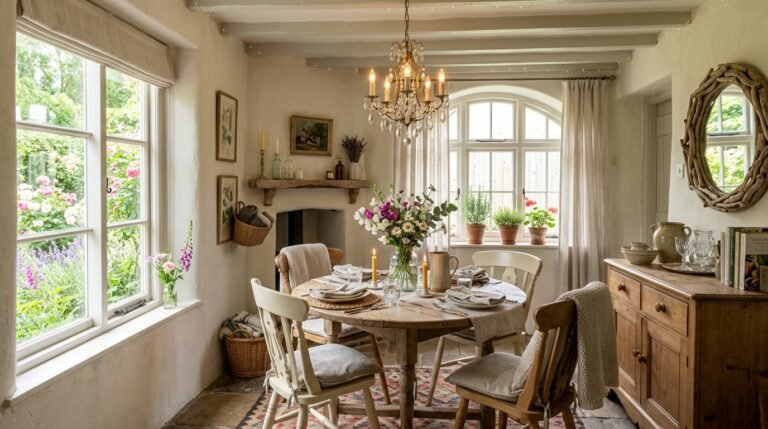
Stone floors. Rough linen curtains. A slightly uneven plaster wall. A woven basket. If you ignore texture and focus only on furniture shape and paint color, the space feels flat.
Traditional homes in southern France used materials available locally. Linen production was common historically. Natural fibers dominated. You need those tactile layers.
A room painted beige with smooth drywall and glossy tile will never feel French country no matter how many carved chairs you add.
Touch matters. Even visually.
Going Too Polished
Perfection is suspicious in a French country interior.
If every cushion is aligned, every vignette symmetrical, every surface spotless like a showroom, you lose the casual ease that defines the style. Rural living was imperfect. Lived-in.
Of course clean is good. I’m not suggesting chaos. But a slight asymmetry, a stack of cookbooks, a casually draped linen throw. That’s the feeling.
A survey from a US home decor association noted that buyers increasingly prefer homes that feel “lived in but curated.” That balance matters here.
French country design breathes. It doesn’t pose.
Forgetting the Landscape Outside
This is subtle but important.
French country style historically connects to the outdoors. Gardens. Olive trees. Lavender fields. Even modest rural homes had some relationship with the land.
If you design the interior meticulously but ignore the exterior, there’s disconnect. Even a small herb garden near the kitchen window shifts the energy.
You don’t need acres. A planter with rosemary. A gravel path. Something that hints at countryside simplicity.
Without that, it can feel staged rather than rooted.
Mixing Too Many Eras Without Understanding Them
Some people toss in baroque mirrors, industrial metal stools, ultra modern lighting, and call it eclectic French country. And sometimes it works. But often it feels confused.
Traditional French provincial furniture draws from historical periods like Louis XV and regional peasant craftsmanship. Curves were intentional. Proportions mattered.
When you mix eras without understanding scale and material harmony, the space becomes visually noisy.
Eclectic is fine. Confusion is not.
The Quiet Truth
You don’t need a literal chateau. Most authentic French country homes were modest farmhouses, not palaces. They prioritized durability. Natural materials. Comfort.
If you remember that, you avoid most mistakes.
Keep the palette soft. Let materials age naturally. Mix pieces thoughtfully. Don’t theme it to death. And please, resist buying twelve identical carved chairs just because they came in a set.
French country design is less about decoration and more about atmosphere. Warmth that feels earned. Slightly imperfect edges. A room that suggests someone cooked there, read there, argued there, lived there.
If your space feels like a movie set, pause. Remove something. Maybe two things.
Sometimes subtraction is the most French decision you can make.